Monday, 23 July 2012

Planet X Cyclocross Disc and Canti Pro Carbon 50/50 tubular wheels

Bit of a rare animal these......


Going disc AND tubular last year forced me and Dave Haygarth to get our own deep section carbon wheels sorted. There just weren't any decent options out there without spending silly money. Cue ensuing ebay shenanagins and some chunky though strong 50mm rims with Novatec hubs arrived for building at the local bike shop. Nice, perfectly adequate but a bit heavy and workmanlike even with 20 hole front and 24 rear, both laced 2X.

Enter Planet X with their usual eye for value and performance and we have the Disc and Canti Pro Carbons - lighter, faster and most probably stronger too. Both front and rear have 24h rims (also 2X), the same rim as on their newest version of the legendary 50mm Pro Carbon wheelsets, 6 bolt hubs and black double butted Pillar spokes. All for £450 £499 They also have the same proprietary braking surface as the road wheels meaning you can swap between bikes if you're not completely converted to disc.

How do they feel compared to my ebay versions? Not like their  original Clydesdale name - they are much lighter and snappier, retaining all the stiffness of my DIY wheels. I don't know what the exact weight is but it must be around about 1500grams, maybe less - their road cousins come in at about 1400grams. They feel, and are, like light race wheels despite their moniker - quick to pick up, responsive when getting out of the saddle, solid.

Gluing up was a dream - the braking surface, a matt finish, extends to the rim bed and gives a perfect surface to lay the glue onto. The profile is fairly shallow too making it easier to seat the tub and glue to the all important edges where adhesion is needed to make them stick right.

They'll be getting a full test shortly so I will report back.

Friday, 20 July 2012

Bull Hill 2012


I've written about the delights of Bull Hill before here - '...a warm up on a monster climb up onto the moor – a descent down a shattered river bed (under 6 inches of water) but posing as a track – a walk/scramble up a 45 degree slope easing off into water logged peat bog caressed by a howling gale – an attempt to shuffle into a run and summit up further steep slope onto Holcombe Moor – before an exhilerating career down the other side, wiping sweat from my eyes and trying not to crash before turning left to go down the shattered river bed again and repeat.'

It still remains one of the most accessible (Friday lunch break) and effective (just over an hour for 3 reps) 3 Peaks cross sessions I've found. This year is no different, though the first session a couple of weeks ago was less of a shock to a pre-Peaks training constitution than in previous years.

Rather than writing, I thought I'd showcase some of the cracking images that Dave Haygarth has taken recently that show you much of the character and beauty of the area.....


Thursday, 12 July 2012

Criterium

It's an evocative enough word - Gallic in tone, though as ever Greek in origin. But one with a relatively short history, first having been coined in the 1970's.

And within that simple word, lies a whole world of intrigue, technical demands and, this being cycle racing, pain. Short and hard, sometimes technically demanding, the crit is not a million miles away from a cross race. Except where cross races don't usually deliver in speed terms, crits produce a speed element more akin to track racing. That speed, over a short course, turns out to be great training for cross and so crits have often been the staple summer diet for cross enthusiasts and specialists. Except this one.

I'd always eschewed crits - part fear, part dislike of a road scene that perhaps unfairly I'd felt to be cliquey and elitist. Either way, far removed from the experience of cross. But, peer pressure is a wonderful thing, and the sight of friend Mark riding his first crit at Preston on a Thursday night convinced me to dip a toe in.

Immediately addictive, it was of course nowhere near as bad as I had imagined. I've done a few now, getting better as I go. Or rather getting dropped less rapidly by the Elite/1/2 riders, getting in some good workouts and improving speed and confidence all the while.


Pic: Neville Llewellyn

Perhaps the most fun was a closed road crit round the lumps and bumps and copious cobbles of Lancaster City Centre. Add in the worst storm/rain event in many years and it was immediately a classic. All the more so as team mate Dave H got 2nd in what was a tailor made course for his skill and power.

I can feel a few more crits coming on before the summer is up - a perfect distraction before the real racing starts in September...........

Tuesday, 5 June 2012

Me and my bike (my bike and I)


Video time, aided and abetted by my youngest.......

Wednesday, 30 May 2012

Embro


Note: this piece was drafted before the appearance of our 1 week of summer in late May. Don't let that put you off - it will be freezing and lashing down again soon and your thoughts will turn to embro again....


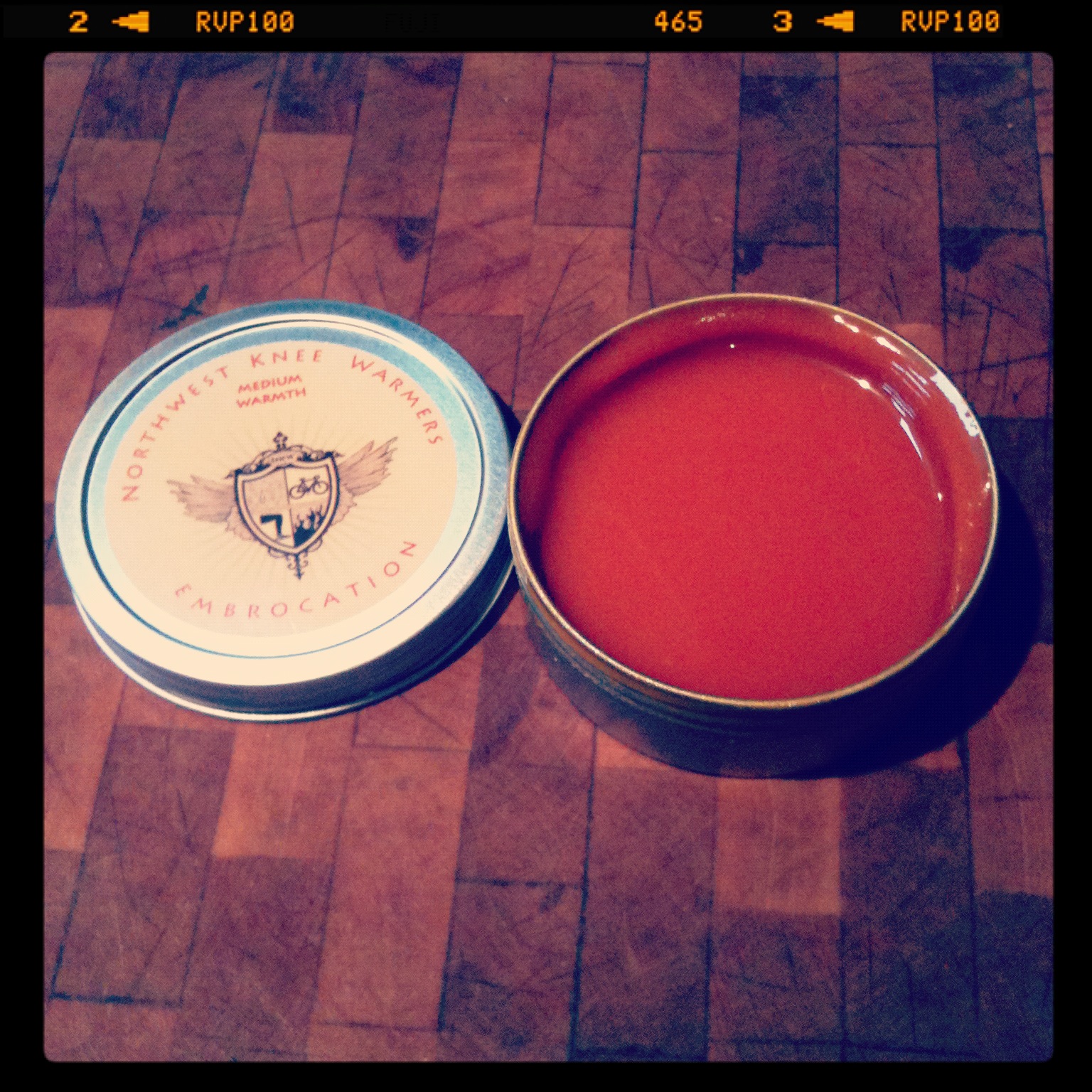
We all love getting packages in the post. This arrival was no exception - a perfectly proportioned little package containing a tin in a plastic bag and a post-it note. I'd been tipped off about my surprise by the sender, John Shaw, former professional off-road rider, Veteran cross racer and fellow Belgo-phile, but more on that later.

Embrocation is to cyclocross as bikinis are to beach volleyball. It would be unthinkable without, though there is one big difference - embrocation actually has a practical use, rather than an aesthetic purpose. Well, it has that too for some, but I digress.

Cross is a winter sport - it's usually cold or wet or cold AND wet unless you live in New South Wales, Australia which incidentally is experiencing a burgeoning cross scene. Even when it's summer cross in the UK, it's usually cold and wet too. Whilst there are obvious benefits of slathering your pasty white legs in something warming when the rain is horizontal and the temperature in single figures, apparently there are other benefits too as embrocation helps increase blood flow to the extremities, which decreases the pain of intense efforts on the bike. That'll be quite handy for cross then....

Either way, legend has it that embrocation originates from Belgium. It probably did, but even if that isn't true, most of us crossers would like that to be true because Belgium is the source of all things good when it comes to cross. Imagine my excitement then when the contents of the package was eponymously labelled 'Northwest Knee Warmers, Medium Warmth Embrocation'.


The smell hit me from the off. To be fair, most embrocation products don't exactly creep up on you when you open them - that would defeat the purpose - but this was very different. Previous versions of embrocation I have used have ranged between the evocative 'school rugby changing rooms' wintergreen smell, the clinical and slightly nasty ralgex reek of sports-type products or more recently the allegedly inspiring smell of an iconic barren-topped mountain in the South of France. This smelt like none of them. It smelt of Christmas, which was mildly unnerving given that it was May. My sense of smell is crap but I definitely picked up cinnamon, clove, mixed spices, maybe pencil, slate.... Maybe not. But cinnamon and clove anyway - warming, comforting winter season smells.

The company behind this festive fare, NorthWest Kneewarmers, is an interesting one. Formed out of the union between a naturopathic physician and a soapmaker they use very different ingredients to many of the other producers out there. Here's what they have to say:

We work hard to find and use the best ingredients possible. The bulk of our ingredients [over 95% by weight] are sourced domestically as close to home as possible, and all are natural. 


We choose ingredients based not only on its area of origin, but its process of manufacture.


We choose materials that have been either expeller/cold pressed [the base oils] or steam distilled [the essential oils], avoiding substances that have been solvent extracted whenever possible. Only one ingredient in our product [the capsaicin] has been solvent extracted as we haven't found it otherwise [yet].


We make the calendula extract ourselves from dried calendula flowers, and put the whole thing together in small batches right here in Oregon.

Well it shows - this stuff is different as I found out when I applied it at a somewhat chilly summer evening cross race in early May. Pretty liquid in texture, you might want to store it in a sealable bag as it shows a clear propensity to escape. This however comes into it's own when you apply - it goes on lovely. It's not overly greasy, but spreads easily and evenly. Whilst I have to my now not-so-secret shame been a past fake tan wearer, I do worry about looking like a badly tango-ed teenage girl, even on my legs. No worries here, smooth and even all the way and a pleasingly darker colour for to help non-Euro pasty legs look a little better.  And shiny too - by American standards, this would qualify for the Euro sheen look which we all know is worth a few seconds a lap.

This incarnation, 'Medium Warmth' is as it says on the tin - pleasantly warming without being too hot. Perfect for Autumn cross, or warmer mid winter days at the races. Or cross in May given the non-appearance of the Spring, let alone the Summer this year. It lasted well too but cleaned off well at the end so I didn't enjoy it's envigorating properties at 1am whilst trying to sleep after the race.

So far so good but the real winner for me was the clear skin-care effects of this embro. The notion of 'skin-care' for some products designed to do the same job can be a little tenuous. With some products, freshly shaved legs can end up looking like you have a dangerous infectious skin disease, such is the rash produced. Even less 'chemical' oriented products can irritate and inflame. This stuff was great - no irritation, and just like in the adverts on tele, 'great feeling skin'  after use. The naturopathic properties are apparent and very welcome.

How do I get some, I hear you ask? Until now, I'm not aware that there has been an offical UK stockist but that is about to change imminently. John Shaw is putting together what can only be described as cross lovers dream - a cross specific emporium filled with hard to find Belgian and US  cross-themed products. It's an idea I flirted with a while back, but didn't have the bottle or the skills to do. No matter, Fangoso, his new venture will fill this gap for me with it's 'passion for grime' ethos.

Look out for more on Fangoso soon.

Tuesday, 15 May 2012

Roubaix: not what it appears to be


Most of the cycling magazines, or internet cycling sites for that matter, carry at least one piece a year about riding the Roubaix cobbles, usually as part of the sportive events that shadow the venerable Paris-Roubaix race in April.

They all use the same adjectives and hyperbole - battering, shaking, bucking, numb, bottle-bouncing, filling-rattling, equipment-destroying etc etc. And they are all right. I don't intend to repeat previous writers descriptions, other than to confirm that riding Carrefour de L'Arbre to take but one example, is deeply unpleasant, unnerving and brutal in its excruciating demands on bike, body and specifically fingers.

Take it as read then that the Roubaix pave is bumpy.....

But on my recent trip, I wanted to scratch below the surface a little, to experience not just the physical demands of the old and broken pave, but to soak up a little of the area's feel and atmosphere - that combination of factors that generates so much hype, attention and fervent adulation on race day in April.

And I found it lacking. Sure, my fingers were in pain, my legs struggled to keep on top of any decent gear to allow forward momentum and my bike felt abused by the brutality of it all. But that was it. The whole experience was curiously inert, at least once the rattling was separated out of my consciousness.


I had chosen to follow the race route and ride four sectors of tactically crucial pave from Cysoing, through Camphin and onto the Carrefour before finishing on the Gruson secteur. A race leader, or even just hopeful finisher will exit that Secteur 3 Gruson stretch with just the much easier Secteurs 2 and 1 remaining before a relieved entry into the Roubaix velodrome and the finish. And maybe this was the point - without the spectacle and intensity and tradition of the race, riding the Roubaix pave just felt like a rather unpleasant and random ride on daft roads, even with the super compliant Ti cx frame and lush 27mm pave tubulars I took over there.

The race route, I realised on tracing it out, is actually fairly contrived. It simply heads off the road for a section of ridiculous pave across the bleak farmland before rejoining a road section after a km or so and rolling onto the next one. Often it rejoins the same road a few hundred metres further up from the point at which it just left, rolling on in to the next village to repeat the process. Without the rhythm of the race, it's cumulative physical and tactical pressure, it just doesn't make sense. And the pave sections, instead of being at the heart of the whole affair, somehow feel like unnecessary intrusions into what might otherwise be a pleasant ride in gently rolling Northern French countryside.

It is then, a very different feel riding here to riding the cobbles and bergs in Flanders that make up one of the other one-day Classics monuments, the Ronde van Vlaanderen. Flanders as an area has an integrity and a character that the terrain covered by Paris-Roubaxi cannot match. The Flemish Ardennes is beautiful in itself, with nooks and crannies that simply invite you to explore them. The flat plains of this part of France have lovely little villages but not the same depth of character to the terrain. The broken and ancient pave here adds character in the context of the race, but on its own, on a rather grey midweek day, all secteurs just look all alike, relics of a bygone era in French agriculture when these still-used country lanes happened to all be cobbled. Sure on race day they come alive and provide an incredible backdrop to the racing and continue the traditions that the race has engendered over the years. But it's not enough, at least not to make a pleasantly memorable ride.

On their own, divest of fans, helicopters and the race cavalcade, the pave for me at least, didn't really provide any more than a vivid insight into the incredible demands of this one race, but did not consitute an experience that, perhaps surprisingly, I will be going back for.

Mark rode stoically on skinny 23mm tires.....

Tuesday, 8 May 2012

Cross and Cobbles - a Belgian road trip


Write up and bike review to come, but here is a taster of said recent trip to Flanders..